
Shoulder pain and restricted movement do not automatically mean that you need an operation. By comparing your symptoms, examination findings, X-rays, non-surgical treatment response and rotator-cuff function, you can identify when surgery is reasonable and which procedure deserves discussion.
Key takeaways
- Persistent night pain and lost movement justify an orthopaedic consultation.
- X-rays show arthritis; MRI assesses the rotator cuff and soft tissues.
- Try medicines, physiotherapy and activity changes before choosing surgery.
- Total or reverse shoulder replacement depends on cartilage and cuff damage.
Which symptoms make a surgical consultation reasonable?
Persistent shoulder pain, night pain, inability to lift your arm, lost external or internal rotation, weakness, or difficulty dressing, reaching overhead, or doing household tasks justify an orthopaedic assessment when they continue despite reasonable self-care. A consultation does not commit you to surgery.
Limited movement alone does not diagnose arthritis. Someone searching for a shoulder movement problem doctor in Pune needs diagnosis before discussing an operation, because stiffness can come from the joint, tendons, capsule or neck.
| Condition | Typical pattern | Why treatment differs |
|---|---|---|
| Glenohumeral osteoarthritis | Deep pain, crepitus and progressively reduced active and passive movement | Joint-surface damage may require arthritis-focused treatment |
| Rheumatoid arthritis | Often affects both shoulders with prolonged inflammatory stiffness and swelling | Blood tests and medical control of inflammation matter |
| Rotator-cuff-tear arthropathy | Weakness, poor active elevation and a painful shoulder despite relatively preserved passive movement | Cuff status determines whether repair or another procedure is possible |
| Frozen shoulder | Marked loss of both active and passive movement, especially rotation | Capsule-directed treatment differs from joint replacement |
| Neck-referred pain | Neck pain, tingling or pain travelling below the shoulder | Cervical-spine assessment may be more useful than shoulder surgery |
Seek urgent assessment for a deformed shoulder after injury, fever with a hot swollen joint, sudden severe weakness or new numbness. A clinician can examine the pain source and decide whether X-rays, blood tests or further assessment are needed.
How do examination and imaging show what is wrong?
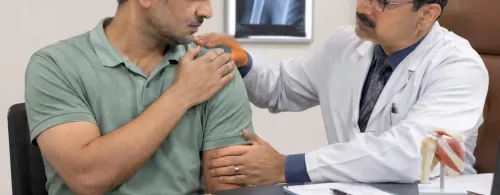
Examination separates stiffness from joint disease, tendon failure, instability or neck-related nerve pain. The clinician compares active movement—what you can do—with passive movement—what the examiner can move. A large gap points toward rotator-cuff weakness; restriction in both suggests joint or capsule disease.
- External rotation and internal rotation
- Elevation, including how high you can lift the arm
- Strength against resistance
- Crepitus, meaning grinding or crackling during movement
- Instability, including slipping or dislocation
- Deltoid function, especially after an injury or prior operation
- Signs of rotator-cuff failure, such as inability to hold or raise the arm
Standing shoulder X-rays usually include anteroposterior, axillary and scapular-Y views. Joint-space loss means the smooth cartilage cushion has become thinner. Osteophytes are extra bone spurs, cysts are small weakened cavities in bone, and bone-on-bone change means the cartilage space has effectively disappeared.
Deformity shows altered bone shape; upward migration of the humeral head means the ball has moved higher because the cuff is no longer centring it. An abnormal X-ray alone does not indicate surgery.
Ultrasound can watch tendons move dynamically and detect tears. MRI helps assess the rotator cuff, cartilage, bone loss and other soft tissues. Blood tests help investigate rheumatoid arthritis or infection. A cervical-spine examination, and imaging when indicated, is needed when neck pain, tingling, numbness or radiating nerve pain could be causing the shoulder symptoms.
What should you try before deciding on surgery?
1. Reduce painful overhead reaching, lifting and repetitive heavy work, but do not stop moving the shoulder completely. Total rest can increase stiffness and make recovery harder.
2. Start supervised physiotherapy for range-of-motion exercises, scapular control and progressive strengthening. Add heat before exercise or for stiffness, and use ice after an activity that aggravates pain. Do not force sharp pain.
3. Use paracetamol or an anti-inflammatory medicine only after a clinician confirms it is safe for your stomach, kidneys, blood pressure, heart and other medicines. A carefully selected corticosteroid injection can provide temporary relief or show whether the joint is the main pain source. It cannot rebuild damaged cartilage, and repeated injections require discussion.
4. Reassess after a defined treatment trial, such as a clinician-agreed period of several weeks, rather than waiting indefinitely. Surgery becomes reasonable when pain, night disturbance and loss of function remain substantial despite appropriate care, and examination and imaging identify a treatable structural problem.
5. A shoulder surgery consultation Dhanori should address whether a diagnostic injection or further imaging would change the decision. Ask what improvement the proposed operation targets and what non-operative option remains. Persistent pain despite treatment is more important than an X-ray alone.
Which operation matches the arthritis and rotator-cuff findings?
An operation must match the damaged structure, not just the stiffness. Arthroscopy uses small incisions for selected loose bodies, tendon or labral disorders and limited joint cleaning. Debridement does not rebuild cartilage or restore an end-stage arthritic surface.
| Operation | What it treats | Key limitation or requirement |
|---|---|---|
| Arthroscopy | Loose bodies, selected tendon or labral problems, limited cleaning | Not a substitute for replacement in end-stage arthritis |
| Rotator-cuff repair | A repairable tendon tear | Fails when the tendon is irreparable or muscle function is inadequate |
| Resurfacing | Selected arthritis with suitable bone and humeral-head shape | Preserves more of the humeral head but is not suitable for every joint |
| Anatomic total shoulder replacement | Advanced painful glenohumeral arthritis | Requires a functioning cuff and enough bone stock for the components |
| Hemiarthroplasty | Damage requiring replacement of the humeral head alone | Leaves the glenoid surface in place, so it has a different role |
| Reverse shoulder replacement | Cuff-tear arthropathy from an irreparable, non-functioning cuff | Relies on a working deltoid; it is not the automatic choice for a stiff shoulder |
Anatomic replacement replaces both the damaged humeral head and glenoid. Reverse replacement changes the ball-and-socket arrangement so the deltoid can raise the arm. Selection considers cuff and deltoid function, bone loss, deformity, age, activity, previous operations, infection risk and imaging—not age or one symptom alone.
If comparing shoulder surgery for arthritis in Dhanori, ask which finding makes the proposed operation appropriate.
What recovery, risks and surgeon questions should shape your decision?
Replacement usually aims for substantial pain relief, not guaranteed normal strength or overhead movement. Persistent stiffness, weakness or difficulty with heavy activity can remain, especially when the rotator cuff, deltoid or shoulder-blade mechanics are abnormal.
| Option | Main principle | Key limitation |
|---|---|---|
| Anatomic total replacement | Replaces the damaged ball and socket while using a functioning rotator cuff | Poor cuff function can undermine the result |
| Reverse replacement | Uses the deltoid to raise the arm when the cuff is irreparable | A nonfunctional deltoid makes the outcome less predictable |
Rehabilitation is part of treatment. Your arm is commonly protected in a sling initially, followed by staged motion and strengthening adjusted to the replacement, tissue healing and your progress. The treating team must set driving, lifting and work restrictions.
- Infection, bleeding, nerve or blood-vessel injury, fracture and stiffness
- Instability or dislocation, loosening or wear, and revision surgery
- With reverse replacement: instability, scapular notching, and acromial or scapular-spine fracture
Ask what diagnosis is being treated, why the proposed operation fits, what alternatives remain, how cuff and deltoid function affect the plan, and how rehabilitation will work. Seek a second opinion for a proposed reverse replacement, mismatched symptoms and imaging, previous trauma or surgery, or a recommendation based on stiffness alone.
A consultation with DR. DEEPAK MUNDE ORTHOPAEDIC SURGEON 08048032510 can help patients in Dhanori compare findings and options. When choosing a shoulder arthritis surgeon Dhanori or shoulder specialist near Viman Nagar, judge relevant training, operation experience, imaging access, rehabilitation support and risk discussions—not distance alone.
Related service
Shoulder Surgery Specialist In Dhanori,Pune Shoulder Surgery Specialist In Dhanori,Pune Dr Deepak Munde is A Reliable and Best Shoulder Surgery Specialist in Dhanori and Best Shoulder Surgery Specialist in Dhanori PUNE. View service → |
Frequently asked questions
When should you seek a shoulder arthritis surgery consultation?
Seek assessment for persistent pain, night pain, weakness, lost rotation, or difficulty dressing, reaching overhead, and doing household tasks despite reasonable self-care.
How do doctors diagnose arthritis and limited shoulder movement?
The examination measures active and passive movement, strength and pain. X-rays show joint-space loss, bone spurs and deformity; MRI evaluates the rotator cuff and other soft tissues.
What treatments should you try before shoulder surgery?
Discuss activity changes, prescribed pain relief, physiotherapy and treatment of related conditions before deciding on surgery. Your plan depends on the diagnosis and medical history.
Which shoulder operation is used for arthritis with rotator-cuff damage?
Anatomic total shoulder replacement suits arthritis with a functioning rotator cuff. Reverse shoulder replacement is considered when cuff damage prevents normal joint movement.
What should you ask before choosing shoulder surgery?
Ask about the exact diagnosis, proposed operation, alternatives, expected movement, rehabilitation length, complications, implant options and the surgeon’s experience with your procedure.
Keywords