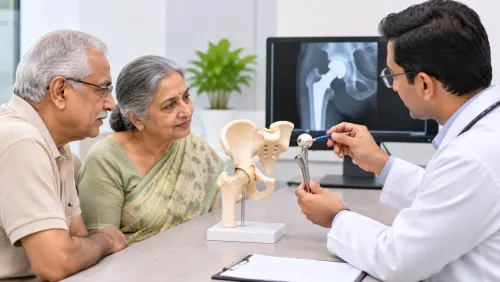

Joint pain does not automatically mean you need an operation, but persistent, recurring or function-limiting symptoms deserve the right level of medical assessment. By the end, you will know when to start with a general practitioner or physiotherapist, when to seek urgent care and when an orthopaedic consultation is the sensible next step.
Key takeaways
- Book an assessment when pain lasts beyond 2 to 3 weeks or limits daily activities.
- Seek same-day care for a deformed, locked, hot, swollen or injured joint.
- Match recurring joint pain with the specialist pathway that fits its pattern.
- Choose specialist review when treatment is not restoring movement or function.
Book an assessment when joint symptoms persist, recur or limit daily life
Pain that is not clearly improving after 2 to 3 weeks of sensible self-care deserves an assessment. Arrange a review sooner if it keeps returning, wakes you at night, or interferes with walking, stairs, dressing, work, sleep or grip.
Book an orthopaedic consultation in Dhanori when you have:
- Persistent pain, stiffness or swelling despite activity adjustment, prescribed exercises, ice or heat, and suitable pain relief.
- Repeated episodes of giving way, catching, clicking with pain, or a joint that locks.
- Reduced movement or strength that prevents a normal task, such as raising your arm or bearing weight.
- Symptoms after an injury that have not steadily improved within 1 to 2 weeks.
- Morning stiffness lasting more than 30 minutes, swelling in several joints, or symptoms affecting both sides; ask a physician about inflammatory arthritis and rheumatology as well.
Do not keep treating numbness, worsening weakness, loss of hand or foot function, or pain travelling from your neck or back as a simple joint problem. These signs need prompt medical assessment. After a major injury, seek urgent care for a visible deformity, suspected dislocation, rapidly increasing swelling or inability to bear weight.
Searches such as “orthopaedic consultation Dhanori” and “joint problem doctor Dhanori” identify local services, not a diagnosis. An orthopaedic surgeon may recommend physiotherapy, medication, bracing, injections, weight management or observation rather than surgery.
Know which joint symptoms need emergency or same-day care
Go to an emergency department or acute-care service instead of waiting for a routine orthopaedic appointment after a serious injury or sudden deterioration.
Seek urgent assessment if you have any of these warning signs:
- A visibly deformed joint, suspected fracture or dislocation, or bone showing through a wound
- Inability to bear weight or use the limb after a fall, collision or twisting injury
- Rapidly increasing swelling, severe pain, or sudden loss of movement
- A hot, swollen joint with fever, chills or feeling acutely unwell; septic arthritis can damage cartilage and spread infection quickly
- A limb that becomes numb, pale, blue or cold after an injury
The right destination depends on what happened and how quickly it changed.
| Where to go | What it means | When it applies |
|---|---|---|
| Emergency department | Immediate examination, imaging and treatment for serious injury or infection | Deformity, suspected fracture or dislocation, inability to bear weight, severe swelling, or a hot joint with fever |
| Same-day doctor or acute-care service | Prompt evaluation before a routine appointment | Sudden movement loss, rapidly worsening pain, or a new swollen joint without clear major trauma |
| Routine orthopaedic consultation | Planned assessment of persistent or recurring symptoms | Pain that is stable, without red flags, and does not prevent safe movement |
The search term joint problem doctor Dhanori does not determine urgency. If you are stable, verify that the clinician assesses non-surgical treatments as well as operations; an emergency warning always takes priority.
Match the joint pattern to the right specialist pathway
A single painful hip, knee, shoulder, ankle, elbow, wrist or finger points first to the pattern—not automatically to surgery. Use this pathway:
| Pattern | Best first pathway | When an orthopaedic surgeon becomes useful |
|---|---|---|
| Hip or knee pain with activity-related stiffness | Primary-care doctor or physiotherapist | Persistent limitation, recurrent swelling, catching, deformity, suspected fracture, or failure of exercise-based care |
| Shoulder pain with reaching or lifting | Physiotherapist or primary-care doctor | Recurrent dislocation, marked weakness, suspected tendon tear, or symptoms that do not improve with rehabilitation |
| Ankle pain after a mild sprain | Physiotherapist or primary-care doctor | Ongoing instability, inability to progress walking, suspected ligament or cartilage injury, or repeated sprains |
| Elbow pain linked to gripping or overuse | Physiotherapist or primary-care doctor | Persistent loss of movement, traumatic injury, or suspected tendon, bone or joint damage |
| Wrist or finger pain confined to one area | Primary-care doctor, physiotherapist or orthopaedic surgeon | A fracture, tendon injury, locking finger, deformity, or continuing loss of hand function |
| Several swollen joints, both sides of the body, or morning stiffness over 30 minutes | Rheumatologist or primary-care doctor | An orthopaedic review may complement, but not replace, inflammatory-arthritis assessment |
| Numbness, progressive weakness, or pain travelling from the neck or back | Neurologist or urgent primary-care assessment | A joint surgeon is not the correct first route unless examination identifies a separate structural joint problem |
A physiotherapist suits uncomplicated sprains, tendinopathy and stiffness; a primary-care doctor helps confirm the diagnosis and arrange tests. Choose an orthopaedic consultation when function keeps declining, the diagnosis is uncertain, or a structural problem needs specialist review.
Seeing a mobility problem specialist in Pune does not commit you to an operation; treatment may remain exercise, medication, bracing, injection or observation.
Understand what happens during an orthopaedic consultation
An orthopaedic surgeon assesses your pain pattern, joint movement, strength, stability, gait, swelling, tenderness and the effect on daily activities. Explain when symptoms began, any injury mechanism, locking, giving way, walking limits, previous treatment, medicines and relevant medical conditions.
For an orthopaedic consultation in Dhanori, bring imaging reports and the actual X-ray or scan images when available.
| Test | What it shows | Why it may be useful |
|---|---|---|
| Physical examination | Movement, strength, alignment and stability | Identifies whether the problem is joint, tendon, ligament or nerve-related |
| X-ray | Bone alignment, fracture and arthritis-related changes | Helps assess weight-bearing joints and longstanding pain |
| Ultrasound | Tendons, fluid and some soft-tissue problems | Useful for selected shoulder, tendon or swelling complaints |
| MRI | Cartilage, meniscus, ligament, muscle and other soft tissue | Considered when examination findings suggest an injury that changes treatment |
| Blood tests | Inflammation, infection or autoimmune clues | Useful when several joints are affected or the joint is hot and swollen |
Seeing a surgeon does not mean you will be advised to have surgery. Treatment may involve exercise therapy, medication, an injection, bracing, weight management or observation. Imaging alone does not decide the treatment. For typical osteoarthritis, arthroscopic lavage or debridement should not routinely be offered because it does not provide meaningful benefit.
Ask what diagnosis the examination supports, which non-surgical options are reasonable, and what improvement each option aims to achieve.
Choose specialist review when non-surgical care is not restoring function
Book a joint-surgeon review after four to six weeks of appropriate non-surgical care if pain, stiffness or weakness still limits stairs, dressing, gripping or sleep. Book sooner when symptoms keep returning, walking distance is declining, the joint locks, gives way, or treatment has not restored practical function.
Referral for osteoarthritis depends on pain and quality of life, not age or a fixed treatment duration.
- Take numbness, progressive weakness, loss of hand or foot function, or pain travelling from your neck or back to a doctor promptly; these signs can point to nerve or spine disease rather than a primary joint problem.
- Ask whether the diagnosis is certain and whether physiotherapy, medication, an injection, a brace, activity changes or observation remain reasonable.
- Ask what operation is being considered, what improvement it targets, the main risks, recovery time and consequences of waiting.
| Route | Choose it when | Next step |
|---|---|---|
| Primary-care doctor or physiotherapist | Mild sprain, tendinopathy or uncomplicated joint pain | Examination and rehabilitation plan |
| Orthopaedic surgeon | Symptoms persist despite suitable care, or locking, instability or structural damage is suspected | Correlate examination with imaging |
| Rheumatologist | Morning stiffness exceeds 30 minutes, several joints swell, or symptoms affect both sides | Assess for inflammatory arthritis |
Before booking an orthopaedic surgeon for joint problems in Dhanori, verify registration and ask whether non-surgical options are assessed. DR. DEEPAK MUNDE ORTHOPAEDIC SURGEON 08048032510 is one local option to evaluate, but a search for a joint pain surgeon near Dhanori should not replace checking the pathway that fits your symptoms.
Related service
Knee Replacement Surgeon In Dhanori,Pune Knee Replacement Surgeon In Dhanori,Pune Dr Deepak Munde is A Reliable and Best Knee Replacement Surgeon in Dhanori and Best Knee Replacement Surgeon in Dhanori PUNE. View service → |
Frequently asked questions
When should you see an orthopaedic surgeon for joint problems?
Book an assessment when pain is not improving after 2 to 3 weeks, keeps returning, wakes you at night, or limits walking, stairs, dressing, work, sleep or grip.
Which joint symptoms need emergency or same-day care?
Seek urgent care for a deformed joint, sudden inability to bear weight or use a limb, a locked joint, or a hot, red, swollen joint with fever.
What happens during an orthopaedic consultation?
The surgeon reviews your symptoms, injury history, medications and daily limitations, examines the joint and movement, and orders imaging or other tests when needed.
When is specialist review needed after non-surgical treatment?
Arrange specialist review when exercises, activity changes, pain treatment or other non-surgical care have not restored movement, strength or daily function.
Keywords