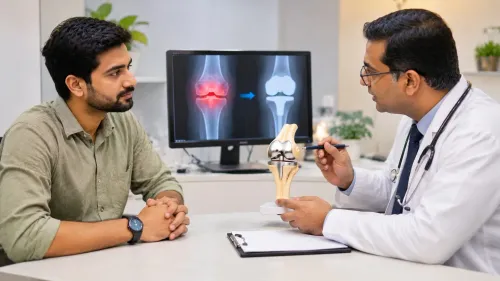

Joint damage becomes a replacement question when pain, stiffness and loss of function continue to limit walking, stairs, work, sleep or independence despite appropriate non-surgical treatment. By the end, you will know which symptoms and test findings support arthroplasty, which alternatives may come first, and when urgent assessment or a second opinion is more appropriate.
Key takeaways
- Discuss arthroplasty when pain limits walking, sleep, work or personal care.
- Review physiotherapy, medicines, injections and walking aids before choosing replacement.
- Match treatment to the cause, such as arthritis, fracture, infection or bone death.
- Seek urgent care for a hot swollen joint, fever, deformity or sudden inability to walk.
Which symptoms suggest that arthroplasty is worth discussing?
Persistent joint pain that limits walking, stairs, work, sleep or personal care justifies an arthroplasty consultation when physiotherapy, activity changes, medicines, weight management, walking aids or injections no longer provide adequate relief. A consultation does not commit you to surgery; it clarifies whether replacement offers more benefit than continued treatment.
| Symptom or finding | What it suggests | Why assessment matters |
|---|---|---|
| Pain during ordinary activity or at rest | Joint damage is affecting daily life | The specialist measures severity, pattern and treatment response |
| Stiffness that restricts walking, sitting or bending | Reduced joint movement may be worsening function | Examination shows whether stiffness comes from the joint or another cause |
| Bow-legged, knock-kneed or other progressive deformity | Joint surfaces may be wearing unevenly | Alignment can influence partial replacement, total replacement or another option |
| Reduced independence, poor walking distance or disturbed sleep | The loss of function may outweigh surgical burdens | Goals, health and rehabilitation capacity determine timing |
An X-ray cannot make the decision by itself. Some people have advanced-looking arthritis with tolerable symptoms, while others have less striking images but disabling pain. Match standing or joint-specific X-rays with your symptoms, examination, goals and response to non-surgical care.
If you searched “when does joint damage need arthroplasty dhanori”, discuss replacement when symptoms are substantial, persistent and function-limiting—not because a report uses the phrase “severe arthritis.” Ask whether the cause is osteoarthritis, inflammatory disease, previous injury or another condition, because that changes the treatment path.
How does the cause of joint damage change the treatment choice?
The cause determines both urgency and the operation. A search for joint damage treatment in Pune should lead to a diagnosis-based plan, not an automatic choice between partial and total replacement.
| Cause | What changes | Usual treatment direction |
|---|---|---|
| Osteoarthritis | Gradual surface wear | Exercise, medicines, aids and injections first; replacement after persistent disability |
| Rheumatoid arthritis | Inflammation damages several joints | Control inflammation; replace a severely destroyed joint |
| Fracture | Bone and joint surface may be displaced | Fix or repair it; replace when reconstruction cannot restore function |
| Avascular necrosis | Loss of blood supply can collapse bone | Decompression early; resurfacing or replacement after collapse |
| Infection | Bacteria can rapidly destroy the joint | Urgent aspiration, antibiotics and drainage; staged replacement when infection is cleared |
| Ligament failure | Instability may be the main problem | Physiotherapy or ligament reconstruction; replacement only with advanced surface damage |
| Cartilage injury | A focal defect differs from whole-joint wear | Rehabilitation, cartilage repair or osteotomy; arthroplasty is not automatic |
| Option | What it does | When it fits |
|---|---|---|
| Conservative care | Reduces pain and preserves movement | Mild or manageable symptoms |
| Repair | Restores a fracture, cartilage, tendon or ligament | A repairable structure remains |
| Osteotomy | Realigns load through the joint | Localised damage with correctable alignment |
| Resurfacing | Caps the damaged bone surface | Selected patients with preserved bone |
| Partial replacement | Replaces one damaged compartment | Disease is limited to that compartment |
| Total replacement | Replaces all major joint surfaces | Widespread destruction and disabling symptoms |
| Fusion | Permanently joins the bones | Severe pain where motion is less valuable than stability |
What happens during a joint replacement consultation in Dhanori?
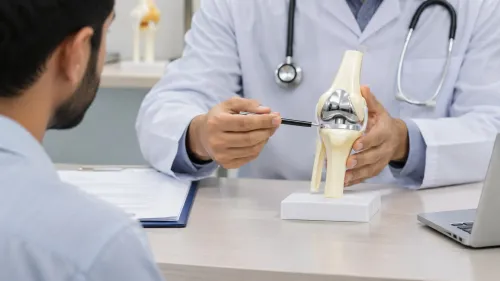
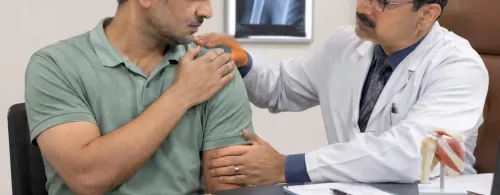
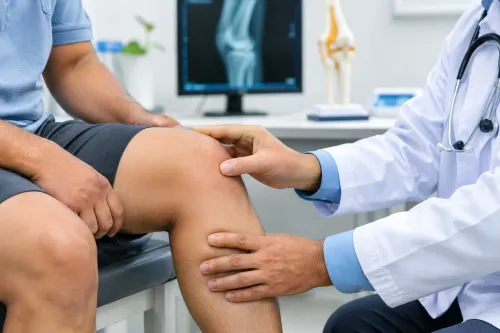
The specialist begins by matching your symptoms to the joint findings: pain at rest or during activity, walking distance, stair difficulty, sleep disruption, stiffness, deformity and loss of independence. They ask what you have already tried, such as physiotherapy, medicines, injections, weight management, activity changes or walking aids, and whether each measure helped.
During a joint replacement consultation in Dhanori, expect review of:
- Your walking pattern, joint alignment, range of motion, swelling, tenderness, muscle strength and ligament stability
- Standing weight-bearing X-rays for knees or hips, or other joint-specific views that show narrowing, deformity and bone loss under load
- MRI only when soft-tissue information is needed, such as suspected ligament, cartilage, tendon or unusual bone problems; it is not routinely needed for typical knee osteoarthritis already clear on examination and X-ray
- Medical history, previous operations, allergies, medicines, diabetes, heart or lung disease, smoking, dental or skin infection, and prior blood clots
- Relevant blood tests, such as a blood count, kidney function, glucose or HbA1c, and infection tests when your history or examination raises concern
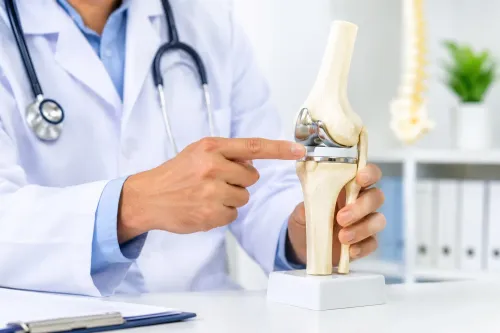
An arthroplasty surgeon in Dhanori should explain whether continued non-operative care, partial replacement, total replacement or another procedure fits your diagnosis and goals. The discussion also covers pre-surgery conditioning, medication adjustments, home support, walking aids, physiotherapy and the expected rehabilitation timetable.
DR. DEEPAK MUNDE ORTHOPAEDIC SURGEON 08048032510 is one local option to assess whether symptoms, examination and imaging justify replacement rather than simply treating an X-ray.
Related services
Arthroplasty Surgeon In Dhanori,Pune Arthroplasty Surgeon In Dhanori,Pune Dr Deepakmunde is A Reliable and Best Arthroplasty Surgeon in Dhanori and Pune. View service → |
Joint Replacement Surgeon In Dhanori,Pune Joint Replacement Surgeon In Dhanori,Pune Dr Deepak Munde is A Reliable and Best Joint Replacement Surgeon in Dhanori and Best Joint Replacement Surgeon in Dhanori PUNE. View service → |
When is joint damage an urgent problem rather than a routine replacement question?
A hot, swollen joint with fever, sudden inability to bear weight, or a newly shortened limb needs prompt assessment, not a routine replacement appointment. These signs can indicate septic arthritis, fracture, dislocation or another injury that requires treatment before arthroplasty is considered.
Seek urgent medical care if you have:
- A joint that is hot, red, swollen and painful, especially with fever, chills or feeling unusually unwell. Infection can rapidly damage the joint and spread into the bloodstream.
- Sudden inability to stand or walk after a fall, twist or direct blow. A fracture can exist even when the skin is intact.
- Severe pain that began suddenly, continues at rest, or is out of proportion to the movement or scan findings.
- A visibly shortened, rotated or misshapen limb after an injury. Do not try to straighten it or walk on it.
- New numbness, tingling, weakness or inability to move the foot, hand or affected joint. These symptoms raise concern about nerve or blood-flow compromise.
- Increasing pain, swelling or wound discharge after joint surgery, an injection or an open injury. Treat this as possible infection.
Do not wait for a routine orthopaedic consultation when these signs appear. Keep the limb still, avoid weight-bearing, and arrange emergency assessment. Once infection, fracture and nerve or vascular compromise have been excluded, persistent pain and disability can be assessed as a planned replacement decision.
How should you judge the expected benefit, risks and timing?
Judge benefit by function, not the X-ray alone. Replacement is more persuasive when pain limits walking, sleep, work or independence despite appropriate treatment, and when stiffness or deformity makes daily activities unreliable. Timing is individual: operating too early exposes you to major surgery without clear gain; waiting until severe deconditioning can make rehabilitation harder.
| Option | Expected benefit | Main limitation or timing issue |
|---|---|---|
| Continued non-surgical care | Preserves the native joint and avoids surgical risk | Benefit is inadequate when pain and disability persist despite treatment |
| Partial replacement or resurfacing | Retains more of the joint in selected damage patterns | Not suitable for every cause, compartment or bone condition |
| Total replacement | More comprehensive pain and function improvement for widespread damage | Major surgery, restricted recovery and possible later revision |
| Fusion | Reliable pain control in selected joints | Sacrifices movement and changes how nearby joints work |
An artificial joint does not guarantee symptom-free movement. Infection, blood clots, wound problems, cardiopulmonary complications, stiffness, dislocation, loosening and wear can occur; revision may be needed. Ask about the implant’s expected lifespan for your age, activity and joint rather than accepting a lifetime promise.
Before elective surgery, address smoking, uncontrolled diabetes, medication interactions and active infection; review dental issues when clinically relevant. Plan transport, home help, exercises, walking aids and follow-up.
Seek a second opinion if the recommendation rests mainly on a scan, symptoms do not match the damage, or implant choice, risks and rehabilitation remain unclear. A damaged joint specialist near me should explain alternatives, cause, expected recovery and revision risk.
Do not delay urgent assessment for fever, suspected fracture or new nerve or circulation problems.
Frequently asked questions
When does joint damage need arthroplasty in Dhanori?
Discuss arthroplasty when persistent joint pain limits walking, stairs, work, sleep or personal care and non-surgical treatment no longer provides adequate relief. A consultation does not commit you to surgery.
How does the cause of joint damage affect treatment choice?
The cause guides the treatment plan. Wear-related arthritis, previous fracture, inflammatory disease, infection and loss of blood supply to bone require different assessments and may not all lead directly to joint replacement.
What happens during a joint replacement consultation in Dhanori?
The consultation reviews your symptoms, walking and daily activities, previous treatment, medical history and medicines. The examination and imaging help determine whether replacement, another procedure or continued non-surgical care offers the better option.
When is joint damage an urgent problem?
Seek urgent medical assessment for a hot, red or rapidly swollen joint, fever with joint pain, a new deformity, severe pain after an injury, or sudden inability to bear weight. These signs can indicate infection, fracture or another problem that should not wait for a routine replacement discussion.
How should you judge the benefit, risks and timing of arthroplasty?
Compare your current pain and loss of function with the expected improvement, recovery demands and surgical risks. Ask what happens if you wait, which treatments remain available, how long rehabilitation takes and what result is realistic for your joint and overall health.
Related services
Hip Joint Replacement Specialist In Dhanori Pune Hip Joint Replacement Specialist In Dhanori Pune Dr Deepak Munde is A Reliable and Best Hip Joint Replacement Surgeon in Dhanori and Best Hip Joint Replacement Surgeon in Dhanori PUNE. View service → |
Knee Replacement Surgeon In Dhanori,Pune Knee Replacement Surgeon In Dhanori,Pune Dr Deepak Munde is A Reliable and Best Knee Replacement Surgeon in Dhanori and Best Knee Replacement Surgeon in Dhanori PUNE. View service → |
Shoulder Surgery Specialist In Dhanori,Pune Shoulder Surgery Specialist In Dhanori,Pune Dr Deepak Munde is A Reliable and Best Shoulder Surgery Specialist in Dhanori and Best Shoulder Surgery Specialist in Dhanori PUNE. View service → |
Keywords