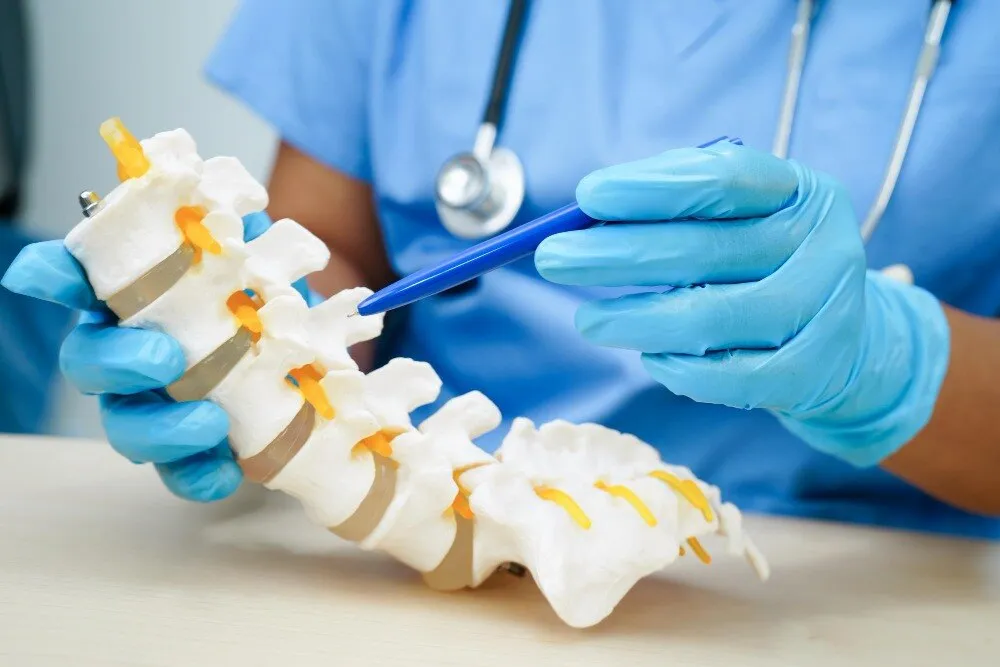
A spine consultation should explain more than what an MRI shows. You need to know which diagnosis matches your symptoms, whether surgery is necessary now, what alternatives remain, and what recovery will involve. Use the questions below to leave a consultation with a clearer decision, not just a procedure name.
Key takeaways
- Ask how MRI findings match your pain, examination and nerve pattern.
- Discuss non-surgical treatment before agreeing to an operation.
- Request the operation name, expected benefit, risks and alternatives in writing.
- Confirm recovery milestones, hospital arrangements and every component of the total cost.
What exactly is causing my symptoms, and how urgent is it?
An abnormal MRI does not prove that it is causing your pain. The diagnosis should connect a specific scan finding with your symptoms, physical examination and nerve pattern. Include this in what to ask a spine surgeon in dhanori in pune:
- “Which vertebra, disc or nerve is affected, and what examination finding supports that diagnosis?”
- “What MRI or X-ray finding explains my symptoms, and which findings are incidental?”
- “Is the target leg pain, numbness, weakness, reduced walking distance or back pain?”
- “Will decompression alone address the problem? If you recommend fusion, what evidence of instability, deformity or another specific indication justifies adding implants?”
Disc bulges, disc degeneration and facet-joint changes become more common with age and appear in people without back pain. Nerve decompression usually has a clearer target when leg pain follows the compressed nerve than when pain is nonspecific lower-back pain.
Ask whether the scan matches the painful nerve distribution and whether non-surgical care has improved pain or function.
Urgency depends on the problem, not the scan wording. Seek prompt assessment for progressive weakness, new loss of bladder or bowel control, numbness around the genitals, fever with severe back pain, suspected infection, cancer or a recent major injury. Otherwise, ask what could happen if you wait and what clinical change would make surgery urgent.
Do I need surgery now, and what should I try first?
Ask a spine specialist near Dhanori to compare each option against your diagnosis, symptoms, examination and daily limitations—not against an MRI image alone. Request a clear answer to: “What happens if I wait three months, and what change would make surgery urgent?”
| Option | What to compare | Ask |
|---|---|---|
| Surgery | Expected benefit, risks, recovery and consequence of delay | “Which symptom is this operation meant to improve?” |
| Waiting | Chance of improvement and monitoring plan | “How often will you review me?” |
| Physiotherapy | Exercise plan, duration and measurable goals | “Should manual therapy accompany exercise?” |
| Medicines | Likely benefit, side effects and stopping plan | “What is the safest option for my conditions?” |
| Activity changes | Movements to avoid and activities to maintain | “Will normal walking or work worsen the problem?” |
| Injections | Temporary relief, risks and effect on later surgery | “What decision will the result change?” |
| Pain management | Non-surgical control of pain, sleep and function | “What is the plan if pain persists?” |
| Second opinion | Agreement on diagnosis, urgency and alternatives | “Which records and images should I take?” |
Do not accept traction, acupuncture or a brace as routine substitutes for a structured exercise programme without discussing the evidence and your diagnosis. Ask what worsening symptoms require emergency care: new bladder or bowel difficulty, numbness around the groin, or progressive leg weakness need urgent assessment.
Get the comparison in writing, then seek a second opinion before elective surgery if the recommendation remains unclear.
Which operation is proposed, and what result should I expect?
The proposed operation should target a named problem—such as a compressed nerve, instability, fracture, infection or tumour—not an MRI abnormality alone. Ask which vertebra and nerve are involved, and which symptoms the operation is expected to improve: radiating leg or arm pain, walking distance, numbness, weakness, or back pain.
| Option | What it means | Typical target |
|---|---|---|
| Decompression | Removes bone, ligament or other tissue pressing on a nerve or spinal cord | Leg or arm pain, walking limitation, and sometimes weakness |
| Discectomy | Removes the disc fragment pressing on a nerve | Sciatica or arm pain from a herniated disc |
| Laminectomy | Removes part of the vertebral lamina, often as decompression | Spinal stenosis causing leg symptoms |
| Fusion | Joins two or more vertebrae with screws, rods or bone graft | Instability, deformity, fracture or painful movement |
| Artificial disc replacement | Replaces a damaged disc while preserving movement | Selected disc-related neck or back pain |
| Minimally invasive surgery | Uses smaller access routes; it describes the technique, not a separate diagnosis | Suitable cases where less muscle disruption is possible |
Ask a back surgeon in Dhanori whether the operation is meant to relieve nerve-related symptoms or nonspecific low-back pain. Nerve decompression has a clearer target for radiating pain than for general back pain, and disc bulges or degeneration can appear in people without symptoms.
- Which symptom is most likely to improve, and which may remain?
- When should numbness or weakness improve?
- What are the estimated benefits, non-improvement risk and chance of recurrent symptoms or another operation?
When comparing a back surgeon, Dhanori patients should request these answers in writing rather than accept “the surgery is safe.”
What are the surgeon’s experience, risks and hospital arrangements?
Before booking a spine surgeon dhanori in pune, verify the doctor’s qualification and registration in the National Medical Commission’s Indian Medical Register. Ask about postgraduate orthopaedic or neurosurgical training, additional spine training, and the number of times the proposed operation has been performed.
Ask for the surgeon’s own rates of infection, nerve injury, dural tear, blood clots, reoperation and, after fusion, failure of bones to unite.
Ask these questions directly:
- Who will perform the operation, make the incision, place the screws or implant, and close the wound?
- Who will provide anaesthesia, and will that anaesthetist remain present throughout?
- Which hospital will be used, and does it have an intensive-care unit, blood bank, urgent MRI or CT, and immediate access to neurosurgical, vascular or medical emergency care?
- If weakness, loss of bladder control, severe bleeding or an anaesthetic problem occurs, who will treat it and how quickly?
- What complications are specific to my operation: nerve or spinal-cord injury, dural leak, infection, implant failure, instability or non-union?
- Which symptom is the operation expected to improve—leg pain, walking distance, numbness, weakness or back pain—and which symptom may remain?
A clinic label does not prove surgical scope. Compare answers with a larger referral hospital in Pune when the operation carries complex neurological or medical risks, and request written details of the named surgical team and hospital before scheduling.
How should I prepare, and what will recovery and the total cost involve?
Bring every record that could change the decision, not only the latest MRI. At your spine surgery consultation in Pune, ask the surgeon to identify the affected vertebra and nerve, explain which finding matches your symptoms, and state what happens if you choose physiotherapy, medicines, activity changes or waiting instead.
Bring:
- MRI, X-ray or CT images on disc or portal access, plus the written reports
- Previous consultation notes, prescriptions, injection records and physiotherapy assessments
- Blood-test, ECG or medical-clearance results already completed
- A list of illnesses, allergies, medicines, smoking history and previous operations
Obtain these instructions in writing before scheduling:
- Which medicines to stop or continue, fasting time, bathing, smoking restrictions and arrival time
- Hospital stay, walking and lifting limits, wound care, driving, physiotherapy and return-to-work targets
- Warning signs, the follow-up date, emergency contact and when the result should be judged
| Operation | Recovery information to request | Cost items to clarify |
|---|---|---|
| Microdiscectomy | Walking, lifting and nerve-recovery expectations | Surgeon, anaesthesia, hospital and readmission |
| Decompression | Wound care, activity limits and physiotherapy | Operating room, medicines and imaging |
| Fusion | Brace, restrictions, bone-healing review and work timeline | Implants, scans, hospital days and revision |
| Fracture fixation | Weight-bearing limits and follow-up imaging | Fixation hardware, emergency care and rehabilitation |
Request a written, itemised Pune estimate covering surgeon, anaesthesia, hospital, operating room, implant, imaging, medicines, physiotherapy and possible readmission. Ask who pays if the operation or implant changes during surgery. DR. DEEPAK MUNDE ORTHOPAEDIC SURGEON 08048032510 can provide a comparison point when you review whether another quote excludes these charges.
Related service
Spine Surgeon In Dhanori,Pune Dr Deepak Munde is A Reliable and Best Spine Surgeon in Dhanori and Best Spine Specialist in Dhanori PUNE. View service → |
Frequently asked questions
What should I ask a spine surgeon about my diagnosis?
Ask which finding explains your symptoms, how it matches your physical examination and nerve pattern, and whether the condition is urgent. An abnormal MRI alone does not prove that it causes your pain.
How do I know whether I need spine surgery now?
Ask what non-surgical options to try first, how long to try them, and what result would trigger surgery. Discuss urgent treatment immediately if you have progressive weakness, loss of bladder or bowel control, or numbness around the groin.
What questions should I ask about the proposed spine operation?
Ask for the exact operation name, the spinal level being treated, its goal, expected improvement, alternatives and the consequences of not having surgery. Request a clear explanation of the main risks.
How can I assess a spine surgeon and hospital before surgery?
Ask about the surgeon’s experience with your specific procedure, who will provide anaesthesia, where the operation will occur, expected hospital stay, infection prevention and emergency arrangements.
What should I ask about spine surgery recovery and cost?
Ask when you can walk, work, drive and lift, which restrictions and physiotherapy you will need, and when follow-up visits occur. Request an itemised estimate covering surgeon fees, hospital charges, implants, tests, medicines and possible additional care.
Keywords