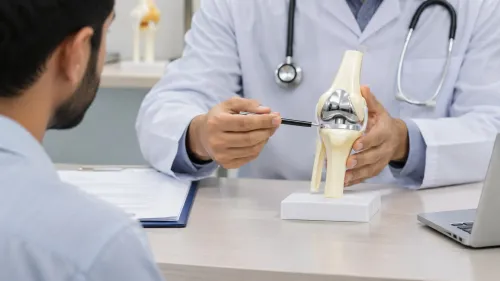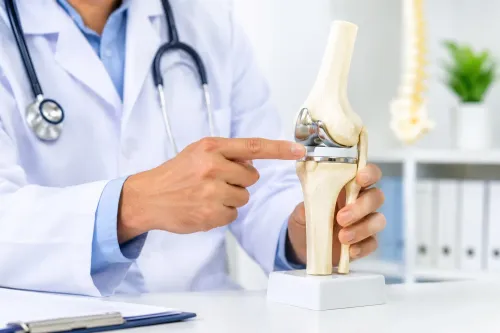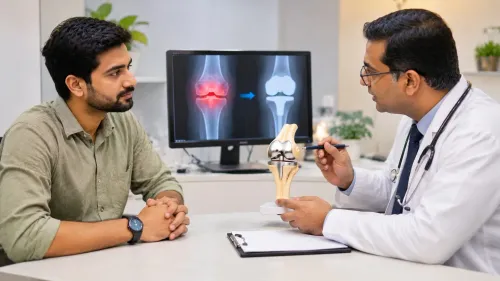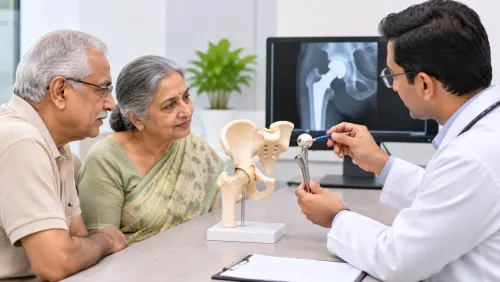
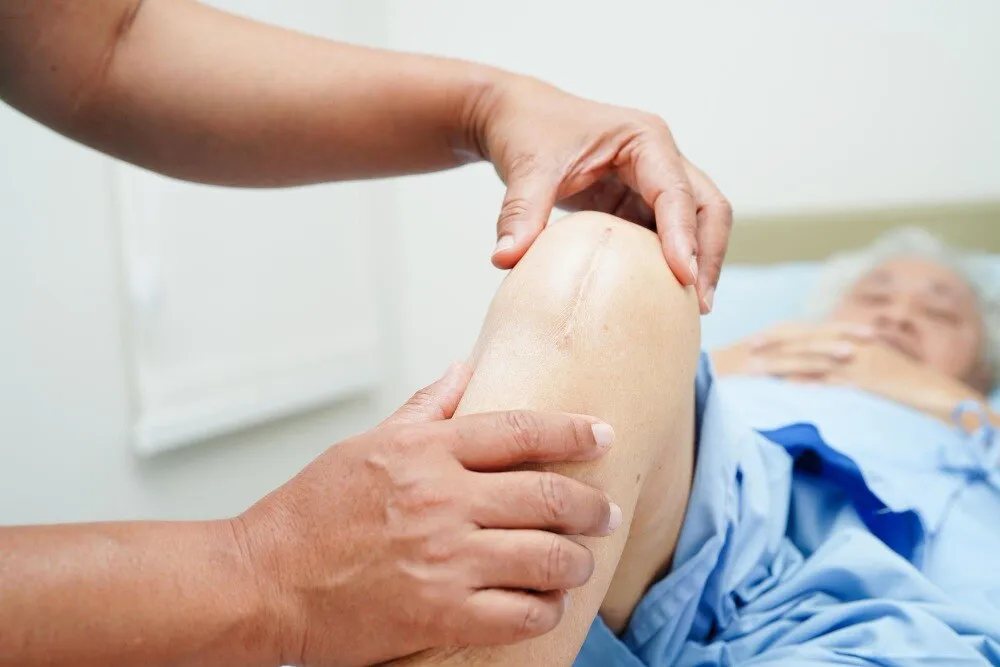
Knee replacement is considered when a specific disease or injury has damaged the joint enough to cause persistent pain and loss of function despite appropriate treatment. By the end, you will know which conditions can reach that stage, which findings support surgery, and when alternatives or further investigation make more sense.
Key takeaways
- End-stage osteoarthritis is the leading reason for total knee replacement.
- Persistent pain, deformity, stiffness and limited walking suggest advanced joint damage.
- Physiotherapy, injections, osteotomy or partial replacement may precede total replacement.
- Bring symptom history, treatment records and recent knee X-rays to your consultation.
Which knee conditions can progress to replacement surgery?
End-stage osteoarthritis is the commonest diagnosis behind knee replacement. Cartilage wears away, the joint space narrows, exposed bone causes painful loading, osteophytes enlarge the joint, and meniscus damage, ligament failure or bow-leg/knock-knee deformity can worsen function.
| Condition | Damage that can lead to replacement | Important distinction |
|---|---|---|
| End-stage osteoarthritis | Widespread cartilage loss, exposed bone, osteophytes, meniscus damage and deformity | Replacement follows disabling symptoms after non-surgical care fails |
| Rheumatoid or inflammatory arthritis | Destruction of cartilage and bone, swelling, stiffness and ligament instability | Control inflammation and assess other joints before surgery |
| Post-traumatic arthritis | Progressive damage years after a fracture, ligament injury or meniscus tear | Previous surgery, scar tissue or altered alignment can make replacement complex |
| Osteonecrosis or avascular necrosis | Loss of blood supply causes femoral-condyle collapse and secondary arthritis | Early, small lesions may avoid replacement; collapse may require it |
| Rapidly destructive or Charcot knee | Severe bone loss, instability and joint destruction | Uncommon; poor bone quality or neurological disease raises complication risk |
| Complex fracture in an older arthritic knee | Joint-surface destruction that cannot be reliably reconstructed | Acute or staged arthroplasty may replace fixation |
A previous knee infection does not automatically rule out replacement, but active infection must be investigated and controlled before elective surgery. A diagnosis alone is not enough: pain, examination findings, bone and ligament condition, functional loss and failure of appropriate treatment must agree.
This matters when researching a degenerative knee condition in pune or knee conditions needing replacement surgery dhanori.
When does knee pain indicate advanced joint damage?
Replacement assessment becomes reasonable when knee pain and loss of function persist despite appropriate non-surgical care. Pain during walking, at rest or at night matters more than an X-ray alone, especially when swelling, stiffness, giving way or difficulty with stairs limits work, sleep or daily activities.
Look for this pattern:
- Walking distance keeps shrinking, or you need a stick or walker.
- Medicines, physiotherapy, quadriceps strengthening, weight management, walking aids or selected injections no longer provide useful relief.
- Pain prevents work, shopping, bathing, driving or sleep.
- The knee feels unstable, repeatedly gives way, or cannot fully bend or straighten.
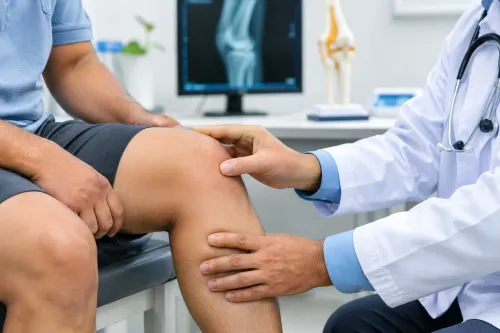
Severe joint-space loss, deformity or bone damage on an X-ray does not justify surgery without meaningful symptoms. Conversely, significant symptoms deserve assessment even when an X-ray is not yet end-stage. Examination and medical history help confirm whether pain comes from the knee rather than the hip or spine.
Standing or weight-bearing X-rays show alignment, joint-space loss, deformity and bone damage.
MRI is not routinely needed for straightforward osteoarthritis. Blood tests or additional imaging can investigate inflammatory arthritis, infection, osteonecrosis, referred pain or an unusual rapidly worsening knee. Seek urgent medical care for a hot, red, swollen knee, fever, sudden inability to bear weight, major injury or rapidly escalating pain.
Which treatments and operations come before or instead of total replacement?
Treatment comes before replacement unless pain and lost function remain substantial. Exercise-based physiotherapy, quadriceps and hip strengthening, weight management when appropriate, safe analgesics or anti-inflammatory medicines, walking aids and selected injections can reduce symptoms, but none can regrow lost cartilage.
Give each option a reasonable trial, then review walking, stairs, sleep and daily activities against your response.
- Use arthroscopy for a specific problem such as a loose fragment or locked knee, not as a substitute for replacement in established, widespread arthritis.
- Consider osteotomy in a selected younger patient with limited joint damage and a correctable alignment problem; it preserves the native knee but is not suitable for diffuse cartilage loss.
| Operation | What it treats | When it applies |
|---|---|---|
| Total knee replacement | Damaged surfaces across the knee, including the femur, tibia and usually the underside of the kneecap | Arthritis or other damage affects multiple compartments and symptoms justify surgery |
| Unicompartmental replacement | The damaged surface in one knee compartment | Disease is confined to one compartment, with suitable ACL, collateral ligaments and remaining knee |
| Osteotomy | Alignment that overloads one damaged area | Younger patient, correctable deformity and limited damage |
| Arthroscopy | A specific mechanical problem inside the joint | Loose body or locking problem, not widespread established arthritis |
Replacement is premature when symptoms remain manageable or pain has not been confirmed as coming from the knee rather than the hip or spine. Active infection, untreated medical risk or damage confined to an area treatable without total replacement also requires correction or a different plan first.
How should you prepare for a knee replacement consultation in Dhanori?
Bring a complete record to your knee replacement consultation in Dhanori so the decision rests on evidence, not one X-ray.
- Prior X-rays, MRI or CT discs and written reports
- Current medicines, painkillers and supplements, including doses
- Injection names and dates
- Previous operation records
- Drug and material allergies
- Diabetes, heart, kidney, lung, bleeding or other medical conditions
- A short diary of walking distance, stair difficulty, night pain and treatments already tried
Ask the knee joint damage surgeon in Dhanori to confirm the diagnosis and explain whether the pain comes from the knee, hip or spine. Ask these questions:
- Is partial or total replacement appropriate, and why?
- Which implant design and fixation method suit my bone, ligaments and activity?
- How will you prevent infection and blood clots?
- How long will I stay in hospital?
- What physiotherapy, walking aid and home preparation will I need?
- What range of movement should I realistically expect?
- When are follow-up visits scheduled?
- How often do you perform this proposed procedure?
| Option | What it treats | Main requirement |
|---|---|---|
| Partial replacement | Damage in one knee compartment | Healthy ACL and collateral ligaments |
| Total replacement | Damage across multiple compartments | Widespread joint-surface disease |
Assess a knee arthritis specialist near Dhanori by looking for examination and imaging that support the diagnosis, a clear discussion of alternatives and a personalised plan rather than a generic promise of replacement. A local orthopaedic consultation with DR. DEEPAK MUNDE ORTHOPAEDIC SURGEON 08048032510 can help connect those findings to an appropriate treatment decision.
Related services
Knee Replacement Surgeon In Dhanori,Pune Knee Replacement Surgeon In Dhanori,Pune Dr Deepak Munde is A Reliable and Best Knee Replacement Surgeon in Dhanori and Best Knee Replacement Surgeon in Dhanori PUNE. View service → |
Joint Replacement Surgeon In Dhanori,Pune Joint Replacement Surgeon In Dhanori,Pune Dr Deepak Munde is A Reliable and Best Joint Replacement Surgeon in Dhanori and Best Joint Replacement Surgeon in Dhanori PUNE. View service → |
What recovery demands and risks should influence the decision?
Pain relief is only one part of the decision: knee replacement also demands weeks of protected movement, rehabilitation and activity limits. Strengthen the quadriceps before surgery when possible, arrange help at home, and clear a route without loose rugs or clutter for walker use.
After surgery, recovery includes:
- Using a walker until balance and leg strength improve.
- Keeping the wound clean and dry, and reporting increasing redness, drainage, fever or wound separation.
- Completing prescribed exercises to regain bending and straightening.
- Using the recommended technique on stairs: lead up with the stronger leg and down with the operated leg while holding the rail.
- Avoiding driving until you can control the vehicle safely and have medical clearance.
- Delaying work until healing, strength and job demands permit it; desk work and heavy physical work require different timelines.
Important risks include infection, blood clots, stiffness, persistent pain, instability, loosening, implant wear, fracture, nerve or blood-vessel injury and revision surgery. Seek urgent care for chest pain, sudden breathlessness or a swollen painful calf.
| Option | Main benefit | Limitation |
|---|---|---|
| Partial replacement | Preserves healthy compartments and more native tissue | Requires damage limited to one compartment and suitable ligaments |
| Total replacement | Treats damage across the knee | Removes more joint surface and does not guarantee normal movement |
| Joint-preserving procedure | Keeps the natural knee | Applies only to selected alignment or local-damage patterns |
Replacement aims to improve pain and function, not guarantee painless kneeling or high-impact activity. Confirm the condition, optimise non-surgical care and medical risks, compare procedures, then proceed when pain and functional loss justify the trade-offs. Age alone should not exclude you, but smoking, obesity, inflammatory disease and other conditions affect preparation and complication risk.
Frequently asked questions
Which knee conditions can progress to replacement surgery?
End-stage osteoarthritis is the most common cause. Rheumatoid arthritis, post-traumatic arthritis after fractures or ligament injuries, osteonecrosis and severe deformity can also damage the joint enough to require replacement.
When does knee pain indicate advanced joint damage?
Warning signs include pain during walking and at rest, night pain, swelling, stiffness, reduced walking distance, difficulty using stairs and a bow-leg or knock-knee deformity. X-rays showing severe joint-space loss, bone contact or large osteophytes help confirm the extent of damage.
Which treatments and operations come before or instead of total replacement?
Treatment can include weight management, physiotherapy, walking aids, pain medicines and injections. Depending on the damage, arthroscopy, high tibial osteotomy or partial knee replacement may be considered. These options do not suit every knee.
How should you prepare for a knee replacement consultation in Dhanori?
Bring previous X-rays or MRI scans, a list of medicines, medical conditions, past operations and details of treatments already tried. Record pain triggers, walking limits, sleep disruption and your goals for surgery.
What recovery demands and risks should influence the decision?
Recovery requires exercises, walking practice and follow-up over several weeks. Discuss infection, blood clots, stiffness, nerve or blood-vessel injury, persistent pain, loosening and the possibility of revision surgery with your orthopaedic surgeon.
Related service
Arthroplasty Surgeon In Dhanori,Pune Arthroplasty Surgeon In Dhanori,Pune Dr Deepakmunde is A Reliable and Best Arthroplasty Surgeon in Dhanori and Pune. View service → |
Keywords