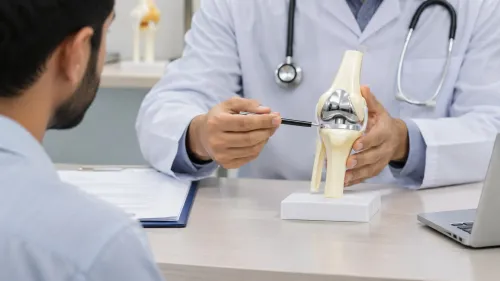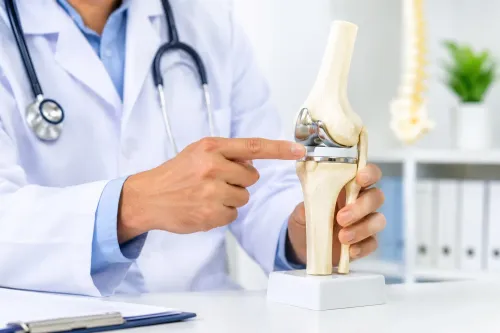
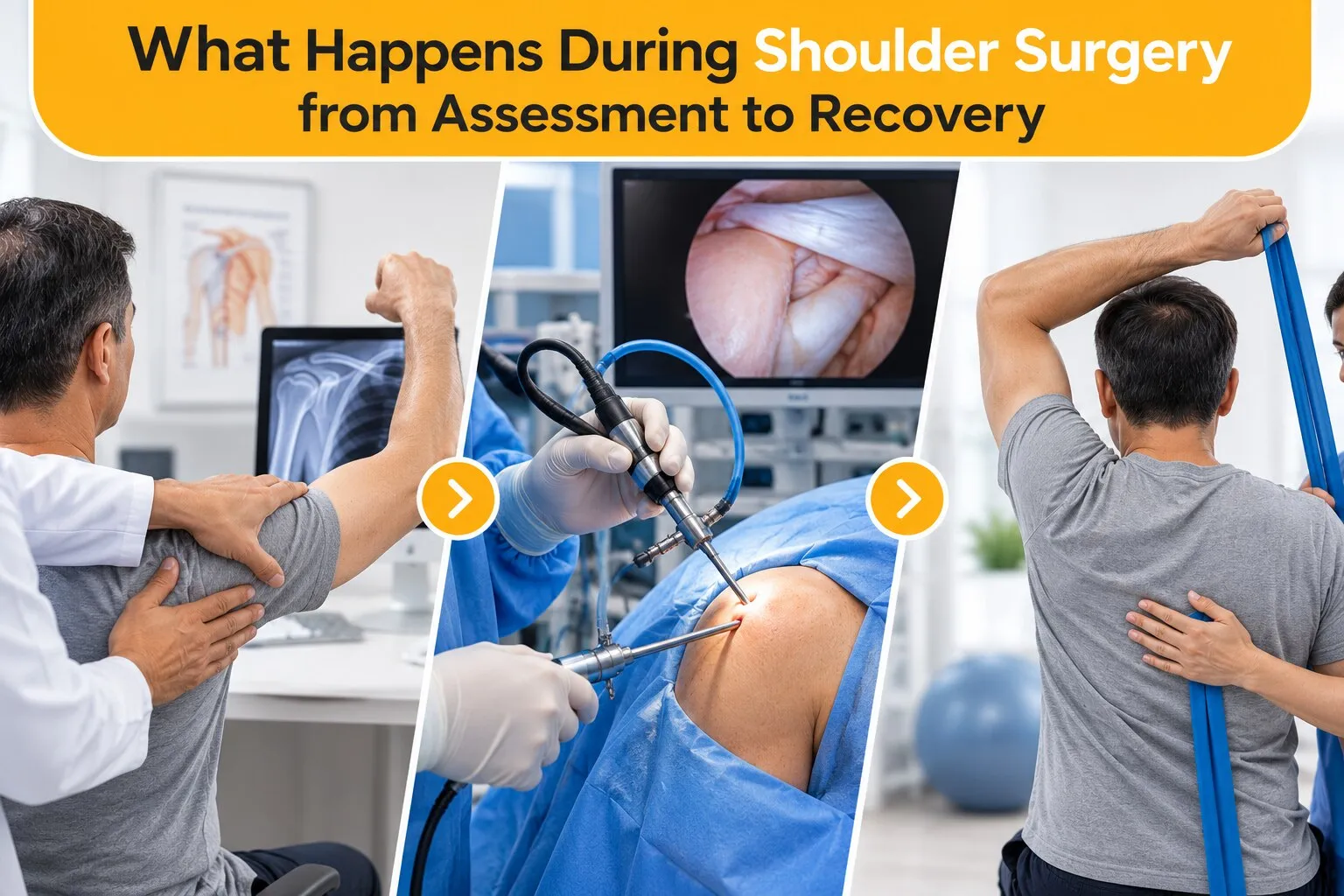
Shoulder surgery is not one standard operation: the assessment, imaging, anaesthetic, restrictions and rehabilitation depend on whether you need a tendon repair, stabilisation, fracture fixation or joint replacement. By following the process from your first consultation through recovery, you can prepare the right questions, organise help at home and recognise symptoms that need urgent medical attention.
Key takeaways
- Your first consultation links shoulder symptoms, examination findings and daily disability.
- X-rays, ultrasound or MRI scans depend on the suspected shoulder condition.
- Arthroscopy, open surgery and replacement suit different injuries and joint problems.
- Recovery involves pain control, wound care and a staged physiotherapy plan.
What happens at the first shoulder consultation?
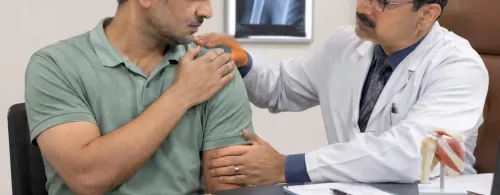
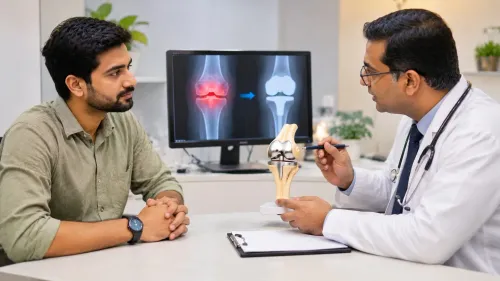
1. The first consultation identifies the shoulder problem before anyone recommends an operation. The surgeon reviews your symptoms, examines the joint and decides whether the diagnosis matches your level of disability.
2. Expect questions about when symptoms began, an injury or fall, pain location, night pain, weakness, clicking and instability. Discuss your work and sport demands, and explain whether pain affects dressing, bathing, reaching or lifting. Bring details of previous physiotherapy, injections, medicines, scans and shoulder operations.
3. The examination looks for swelling or deformity and compares active movement, which you perform, with passive movement, which the examiner guides. The surgeon tests rotator-cuff and general shoulder strength, assesses instability, and checks sensation, pulses and nerve function throughout the arm.
4. A rotator-cuff tear does not automatically require surgery. When the diagnosis fits, activity modification, physiotherapy, anti-inflammatory treatment or an injection may be reasonable. Surgery becomes more relevant when pain or weakness persists, daily function remains limited, or an acute repairable tear needs early treatment.
5. If you are comparing a shoulder surgeon in Pune or a shoulder specialist near Yerwada, ask these questions:
- What is the exact diagnosis?
- Why is surgery recommended now rather than continued non-surgical care?
- What result should I expect without surgery?
- Which treatment has been tried, and what evidence shows it failed?
- How will the diagnosis and examination findings affect the proposed operation?
Confirm the clinician’s registration and qualifications, who will provide postoperative review, and where supervised physiotherapy will take place.
Which shoulder scans are needed before surgery?
Plain shoulder X-rays usually come first because they show fracture position, arthritis, bone spurs, joint-space loss, dislocation, alignment and bone quality. They do not show most rotator-cuff tendon or labral injuries.
| Investigation | What it contributes | When it helps |
|---|---|---|
| X-ray | Shows bone shape, alignment, arthritis and fracture details | Initial assessment and replacement planning |
| Ultrasound | Examines rotator-cuff tendons while the arm moves and compares both shoulders | Suspected cuff tear when dynamic assessment is useful |
| MRI | Shows the rotator cuff, labrum, cartilage, muscle quality, swelling and other soft tissues | Suspected tendon, labral or cartilage injury |
| CT scan | Produces detailed three-dimensional images of bone | Complex fracture, bone loss or detailed replacement planning |
Ultrasound findings depend on the operator and the structure being examined. MRI gives more soft-tissue detail, but the scan alone does not decide the operation.
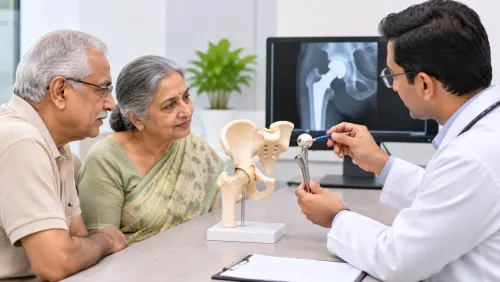
The surgeon matches the images with your symptoms, examination findings, age, activity, tear pattern, bone condition and previous treatment. For anyone reviewing the shoulder surgery process in Dhanori, that match explains why treatment might involve arthroscopic rotator-cuff repair or decompression, labral stabilisation, fracture fixation, anatomic total shoulder replacement or reverse replacement.
Anatomic replacement usually suits painful arthritis when the rotator cuff works. Reverse replacement changes the joint mechanics and is used when cuff failure makes anatomic replacement unreliable. The same scan can lead to different operations when the examination or tissue quality differs.
How do you prepare for shoulder surgery in Dhanori?
Prepare transport, medication information and home support before admission; these details determine whether a day-case shoulder operation is safe. Give the team a complete list of:
- Aspirin and blood thinners
- Diabetes medicines
- Vitamins, herbal supplements and other supplements
- Over-the-counter pain medicines
Report allergies, previous anaesthetic problems, sleep apnoea, diabetes, heart or lung disease, and smoking. The surgeon, anaesthetist and prescribing doctor will decide what to stop or continue. Do not change any medicine independently.
Follow the hospital’s exact fasting instructions for food, water and clear liquids; timing depends on the anaesthetic plan. Complete requested blood tests, heart checks or other medical assessments. Stop smoking before surgery because nicotine slows tendon, bone and wound healing.
| Arrange before admission | Why it matters |
|---|---|
| Transport and an adult at home | You must not drive after anaesthesia, a nerve block or opioid pain medicine |
| Loose front-opening clothes | They are easier to wear over a sling |
| Protected sleeping position | It prevents pressure on the operated arm |
| Help with bathing, dressing, meals and household tasks | One-handed activities are difficult initially |
On the day, staff confirm your identity, allergies and procedure, obtain consent, mark the operative shoulder and record vital signs. The anaesthetist explains general anaesthesia and, when suitable, a regional nerve block, including numbness duration and complications. After surgery, recovery staff monitor breathing, circulation, pain and alertness.
Discharge requires stable observations, manageable pain and safe accompaniment. For what happens during shoulder surgery in Dhanori and shoulder operation recovery Dhanori planning, DR. DEEPAK MUNDE ORTHOPAEDIC SURGEON 08048032510 can clarify follow-up and written restrictions.
Related service
Shoulder Surgery Specialist In Dhanori,Pune Shoulder Surgery Specialist In Dhanori,Pune Dr Deepak Munde is A Reliable and Best Shoulder Surgery Specialist in Dhanori and Best Shoulder Surgery Specialist in Dhanori PUNE. View service → |
How do arthroscopy, open surgery and replacement differ?
The operation name does not predict the recovery. Arthroscopy uses a camera and instruments through several small portals, but the surgeon may repair a rotator cuff or labrum with sutures and anchors, remove damaged tissue or treat inflammation. Small incisions do not mean a small repair: tendon-to-bone healing still takes time.
Open surgery uses a larger incision when direct access is needed for fracture fixation or complex reconstruction. Plates, screws or wires may hold a fracture, while anchors secure soft-tissue repairs.
| Operation | What it involves | Why restrictions differ |
|---|---|---|
| Arthroscopy | Camera, instruments, anchors or sutures through small portals | The repaired tendon or labrum needs protection despite small wounds |
| Open surgery | Direct access through a larger incision; plates, screws, wires or anchors may be used | Bone and soft-tissue healing determines sling use and movement |
| Anatomic total replacement | Damaged joint surfaces replaced with metal and plastic components | It preserves the usual ball-and-socket arrangement and needs a functioning rotator cuff |
| Reverse replacement | Joint geometry is switched to rely more on the deltoid | It can restore useful elevation with an irreparably deficient cuff, but rotation may remain limited; heavy lifting and dislocation risks remain |
Ask which exact procedure is planned, whether it is arthroscopic or open, which implants or anchors will be used, how long the sling is required and which movements are forbidden. These details matter more than a search for shoulder surgery process Dhanori or shoulder operation recovery Dhanori; the operation controls recovery, not the Pune locality.
What should you expect during shoulder operation recovery?
Pain usually needs a planned approach rather than extra medication. Follow the prescribed pain-medicine schedule, and check with the surgical team before adding any tablet. Apply ice only as instructed, place a cloth barrier between ice and skin, and keep the sling on for the stated periods.
Arrange help with dressing, bathing, meals and transport to follow-up visits.
| Operation | Early protection and therapy | Recovery pattern |
|---|---|---|
| Rotator-cuff repair | Sling commonly lasts about four to six weeks; passive movement comes before active use and resisted strengthening | Tendon-to-bone healing is slow, so the written protocol controls |
| Shoulder replacement | Move the hand, wrist and elbow early, then perform prescribed shoulder exercises | Light activities may improve over weeks; strength and function develop for months |
Do not use an internet timetable to decide when to drive, work, lift or play sport. Before consent, ask about infection, bleeding, blood clots, anaesthetic complications, nerve or blood-vessel injury, stiffness, persistent pain, re-tear, failed repair and instability; replacement also carries risks of loosening, wear and dislocation.
- Increasing redness, wound drainage or fever
- Pain that worsens instead of gradually improving
- New numbness, weakness or marked arm swelling
- Chest pain or shortness of breath
If you are planning shoulder operation recovery in Dhanori, confirm written restrictions and emergency arrangements. A shoulder surgeon in Pune or shoulder specialist near Yerwada should also explain who will provide postoperative review and supervised rehabilitation.
Frequently asked questions
What happens at the first shoulder consultation?
The surgeon reviews your pain, weakness and movement limits, examines the shoulder and checks whether the diagnosis explains your disability before recommending surgery.
Which shoulder scans are needed before surgery?
The scan depends on the suspected problem. X-rays show bones and joint space, ultrasound assesses tendons dynamically, and MRI provides detailed views of rotator-cuff tears, cartilage and other soft tissues.
How do you prepare for shoulder surgery in Dhanori?
Discuss your medicines and medical conditions, complete requested tests, arrange transport and home support, follow fasting instructions, and plan for the prescribed sling and physiotherapy.
How do arthroscopy, open surgery and replacement differ?
Arthroscopy uses a camera and small incisions, open surgery uses a larger incision for direct access, and shoulder replacement resurfaces or replaces damaged joint surfaces.
What should you expect during shoulder operation recovery?
Expect a protected early phase with pain management and wound care, followed by guided range-of-motion and strengthening exercises. Recovery time depends on the procedure and tissue healing.
Keywords